


I believe hospitality is one of the greatest contributors to human wellbeing. Not because it solves our problems, but because, at its best, it cleverly eases the weight we’re already carrying. Additionally, it teaches others how to be gracious and kind. It reduces uncertainty and creates belonging.
Hospitality is a discipline capable of having a profound impact on human wellbeing. Lucky for us, hospitality can be experienced daily in a variety of ways. This largely depends on our choices, but even the smallest, almost seemingly indistinct interaction provides an opportunity for thoughtful hospitality, no matter how delicate in touch.
The immediacy of thoughtful hospitality perfectly executed can be imperceptible. But with sustained consistency it can leave a lasting impression one may struggle to articulate, rendering its imprint so whole, the mind, body and soul crave its repetition.
The challenge to providers, the minds behind the scenes, the educators of exceptional hospitality, is not to blow the candle out by over-doing it, numbing the being to thoughtfulness. Worse, extinguishing all that is good by creating a society of ungrateful expectants.
I am fascinated by how society behaves in a hospitality setting. Moreover, how hospitality is given. The power of thought and the human response to it. And then the by-product of that cause and effect exchange.
I have studied the why: why we crave, and then spun it on it’s head with the study of the paradoxical state of rejecting what we actually desire, and interestingly, overchoice, where more is often less. Applying this human response to hospitality provides infinite opportunities to be thoughtful and intentional, thus enhancing the lived experience of the recipient. Creating societies that are envied for their wellbeing, ultimately creating an existence that we can be proud of, that we can rely upon when we need to feel something. To feel connected, to feel seen, to belong.
Hospitality and design (interior, architecture, environment), and hospitality and human emotion are exciting, because of their malleability. Just because something is the way it is, does not mean that is the way it must stay.
When approached in this way, hospitality is the return to base: the creative bible of the human ability to directly enhance another human’s wellbeing.
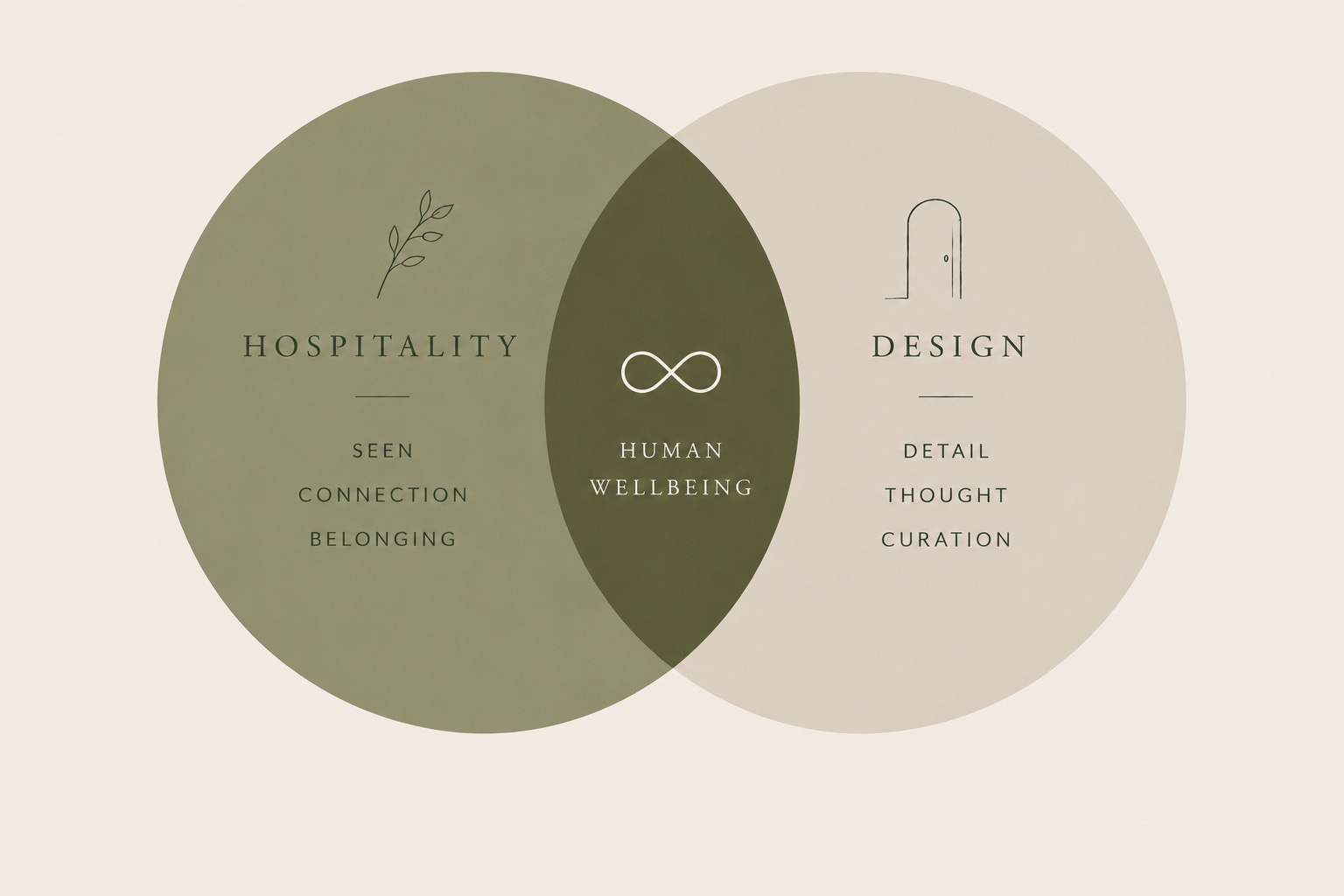
Hospitality is never created by one person. It’s the result of hundreds of thoughtful decisions, made by people we may never meet.
The architect who frames the view.
The designer who considers how a room should feel.
The art curator who chooses the pieces that evoke emotion.
The florist.
The housekeeper.
The chef.
The receptionist.
The person who handwrites the note left in your room.
Curating, collaborating, working cohesively. Each person, every team member, leaves a fingerprint on the experience, bringing it into focus.
Together, they shape how another human being feels.
This is why I find hospitality so compelling.
Not just because I love beautiful hotels, and not only because I admire exceptional service, but because hospitality offers huge opportunity and choice.
These Field Notes will provide a lens through which to observe the impact of hospitality, with the clear intention of provoking thought and encouraging a commitment to excellence motivated by genuine empathy for human experience. Whilst hospitality is experienced in a variety of sectors, my expertise lies in hotels and food & beverage.
I look closely at the decisions, behaviours and environments that shape how people feel. My belief is that if we better understand the human response to hospitality we can create places that enhance people’s wellbeing.
/Heidi